The expanded background behind SumHealth Search, including the regulatory context, patient impact, provider use cases, and the product’s long-term direction.
SumHealth Search: Bringing Clarity to the Cost of Health for Anyone, Anywhere
Healthcare is one of the few major purchases people are routinely asked to make without knowing the price first. For patients, providers, and the people working to improve the system, that uncertainty can create confusion, frustration, and real financial hardship.
The economics of healthcare directly affect the care people can access and the outcomes a system can deliver. Yet the cost of a service is often difficult to understand before care takes place. Hospital pricing can reflect insurance negotiations, bundled services, and the specific circumstances of an individual patient. Those factors make healthcare different from a typical consumer market, but they do not make clear information any less important.
Patients are often making decisions while vulnerable or unwell. They should not be surprised by a bill they had no practical way to anticipate. Price transparency is therefore more than an administrative requirement. It is part of treating people with respect and giving them a reasonable opportunity to make informed decisions.
The Hospital Price Transparency Rule
The federal Hospital Price Transparency Rule took effect in January 2021. It requires hospitals to make pricing information available online for the items and services they provide, including standard charges and certain negotiated rates.
The rule was created in response to rising healthcare costs and the difficulty patients faced when trying to understand the financial consequences of care. By making pricing information more accessible, policymakers intended to help consumers compare options and encourage competition among hospitals.
The Centers for Medicare & Medicaid Services administers and enforces these requirements. CMS also publishes technical guidance, updates, and public information intended to help hospitals understand what they must disclose.
Publication was an important step, but it did not solve the entire problem. Hospital machine-readable files can be large, technically complex, and inconsistent from one organization to another. Compliance and usability also vary. A file can satisfy a disclosure requirement while remaining difficult for an ordinary person to interpret.
Noncompliance has consequences
CMS can impose civil monetary penalties on hospitals that fail to meet federal price-transparency requirements. Penalties vary based on hospital size and the duration of noncompliance, and enforcement standards can change as regulations are updated.
Financial penalties are only one consequence. When pricing information is incomplete, inconsistent, or difficult to use, patients lose the ability to compare services. Providers have less context for discussing costs. Employers, health plans, researchers, and other healthcare organizations have a harder time understanding what care costs across a market.
The original purpose of transparency is not simply to create more files. It is to make healthcare pricing usable for the people who make, receive, and pay for care.
Introducing SumHealth Search
SumHealth Search is designed to turn complex hospital pricing data into a straightforward search experience.
Instead of requiring users to locate and interpret individual hospital files, the product organizes available pricing information around a familiar question: What does a specific procedure cost near me?
Users can search by procedure name or CPT code, enter a ZIP code, and compare published cash-price information from available facilities and providers. The interface is built for people with different levels of healthcare and technical knowledge.
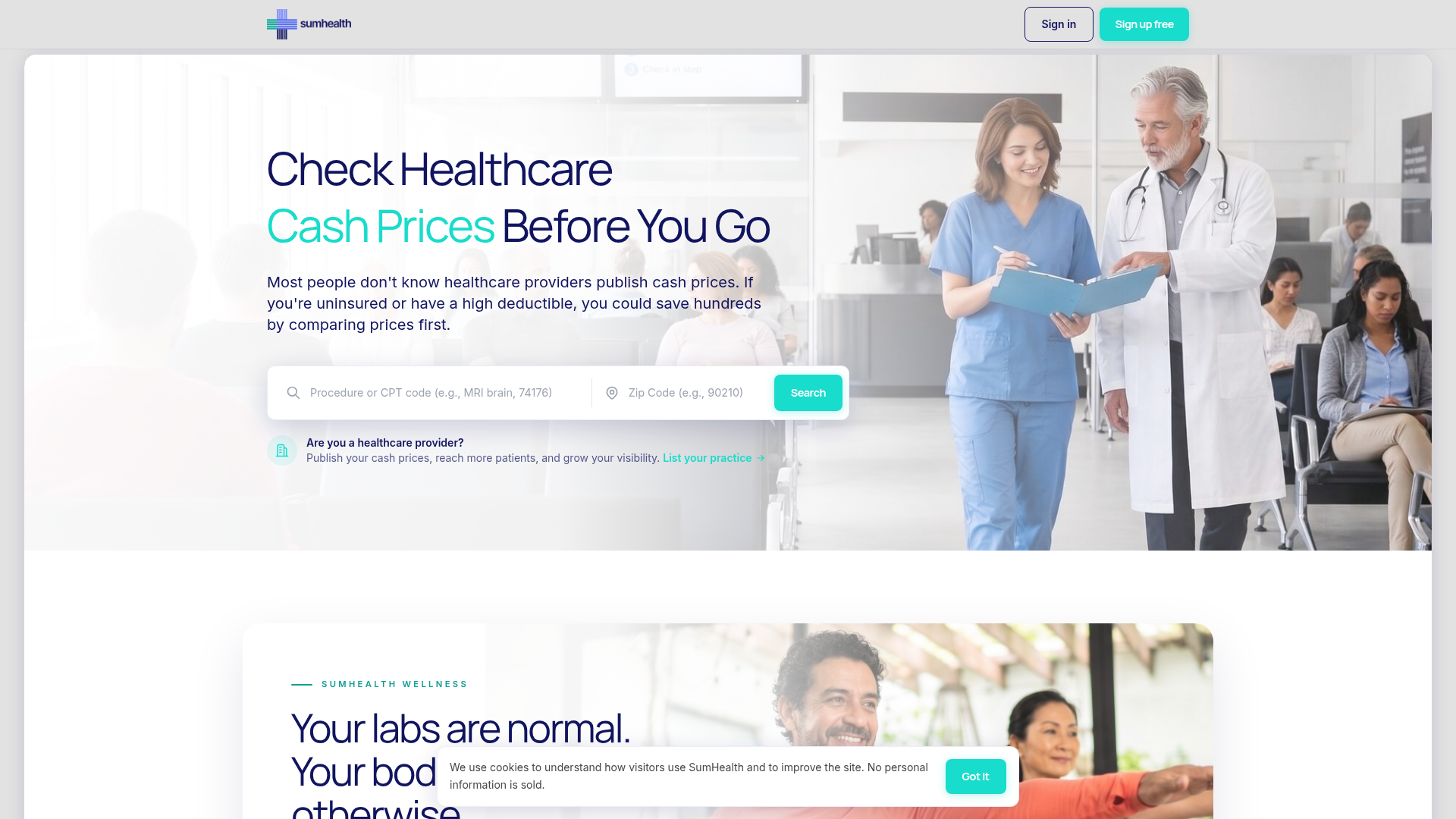
Published prices should be treated as a comparison starting point, not a guaranteed estimate. The final amount can depend on the exact services delivered and the patient’s circumstances. Before receiving care, patients should confirm what is included and verify the complete price directly with the hospital or provider.
A patient-centered mission
For too long, patients have navigated healthcare pricing with limited information. They may receive a recommended procedure, choose a facility, and schedule care without a practical way to compare the published cash price with nearby options.
Clearer information gives patients a better starting point. It can help them:
- Search for a procedure by name or CPT code
- Review published prices in a chosen area
- Compare available facilities and providers
- Ask more specific questions before scheduling care
- Understand when a quoted amount needs additional confirmation
Transparency cannot remove every uncertainty from healthcare billing. It can, however, make the financial side of a decision less opaque and support a more informed conversation between a patient and the organization providing care.
Helping providers and healthcare organizations act more effectively
SumHealth Search is not only for patients. Pricing information can also support providers, health plans, employers, researchers, and healthcare organizations.
Comparable market information can help organizations understand local pricing patterns, evaluate how rates differ across facilities, and communicate more clearly with patients. Normalized data can support strategy, compliance, contracting, and patient-engagement work that is difficult to perform when the underlying information remains fragmented.
SumHealth’s broader pricing-data work focuses on processing complicated hospital and payer information and making it practical for the people who need to act on it. SumHealth Search is a public-facing expression of that mission.
A direct path for providers
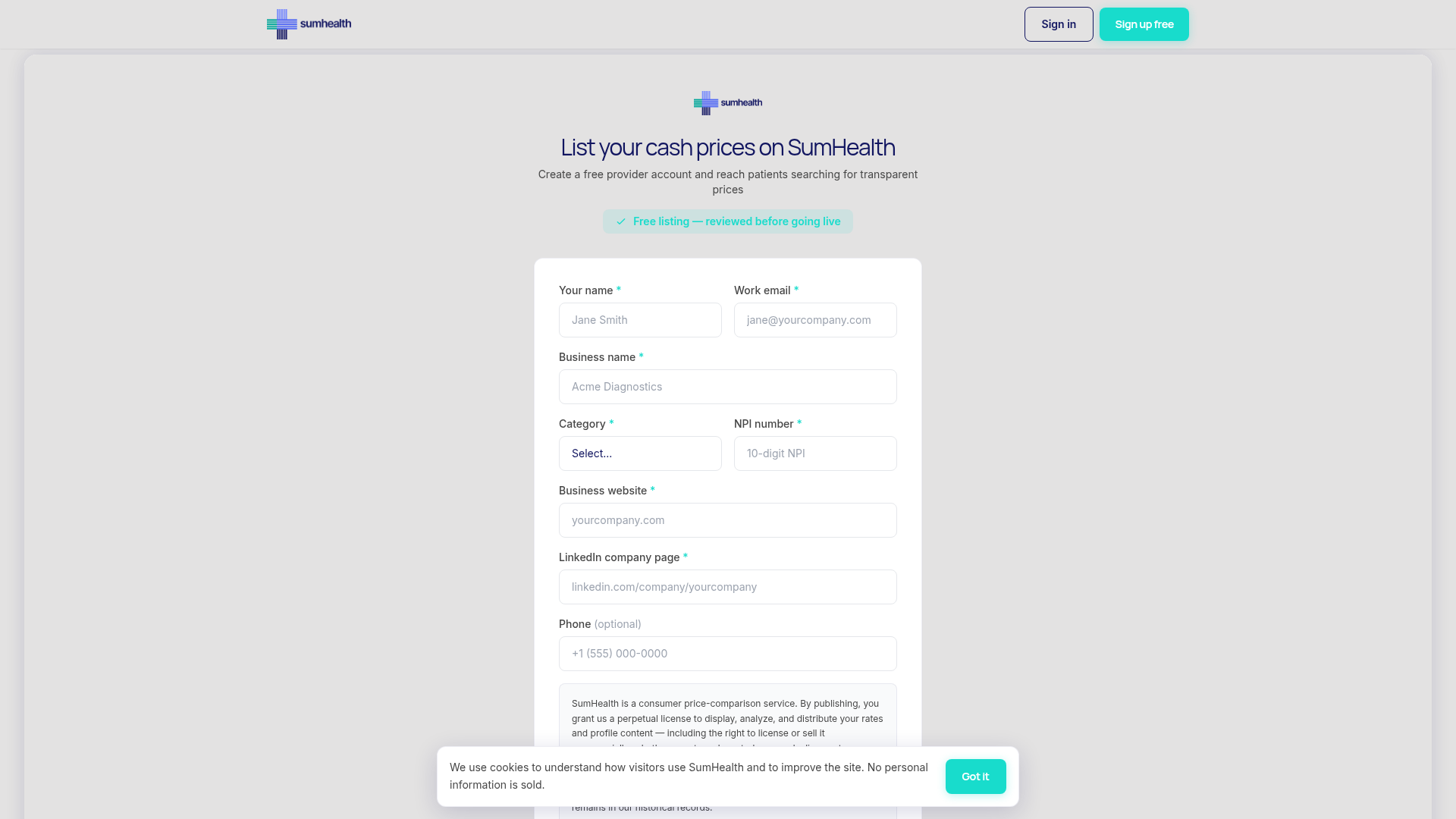
Independent practices, imaging centers, laboratories, and other healthcare businesses can also submit a free provider listing for review.
By publishing clear cash prices, a provider can make it easier for patients to understand available services and compare local options. A listing can also help a practice reach cash-pay patients who are actively looking for transparent care.
Providers can use the listing flow to:
- Submit practice information
- Publish cash prices for the services they offer
- Improve visibility with people comparing local options
- Keep their information current without exchanging spreadsheets
List your practice on SumHealth Search
Supporting transparency and compliance
Healthcare organizations may need more than a downloadable file. They may also need a reliable way to organize, maintain, and present pricing information to patients and partners.
A well-designed presentation layer can help an organization align price information with its brand and patient-engagement strategy while reducing the technical burden associated with data curation. It can also demonstrate that transparency is being treated as an ongoing service commitment rather than a one-time compliance exercise.
The goal is to make published information easier to maintain, easier to understand, and more useful to the people it is intended to serve.
The future of pricing clarity
Search is the foundation. Over time, pricing tools can go further by helping users compare the same procedure across facilities, understand the components of a price, and identify questions to ask before receiving care.
Future capabilities may also help people explore the relationship between a planned course of care and the services that could accompany it. These tools must be developed carefully: published prices and generalized comparisons should never be presented as guaranteed patient-specific estimates.
The direction is clear. Better-organized data can support practical guidance, more informed decisions, and a healthcare market in which cost is easier to discuss before a bill arrives.
A more transparent healthcare experience
Launching SumHealth Search is an important step in SumHealth’s mission to make healthcare pricing more accessible and useful.
Patients need a clearer place to begin. Providers need a simple way to publish and explain prices. Healthcare organizations need normalized information they can use for strategy, compliance, and patient engagement. Researchers and analysts need structured data that reveals patterns hidden inside fragmented disclosures.
Whether you are comparing an upcoming procedure, publishing prices for a practice, or studying healthcare markets, SumHealth Search is designed to help turn pricing data into information you can use.
Search healthcare cash prices with SumHealth Search
Sources and further reading
- CMS Hospital Price Transparency
- JAMA: Assessment of Hospital Compliance With Federal Price Transparency Requirements
Regulations, enforcement policies, and penalty amounts can change. Consult current CMS guidance for authoritative compliance requirements.