What is healthcare
price transparency?
For nearly a century, the price of American healthcare was a secret — locked in chargemasters and negotiated behind closed doors. Then, law by law and fine by fine, the prices came out. This is the story of how it happened.
The Opaque Era
For most of the last century, Americans had no realistic way to learn what a hospital visit would cost before the bill arrived. Prices existed — they were just hidden.
Insurance hides the price tag
Before the Great Depression, most American healthcare was paid in cash — and patients cared deeply about prices. As private health insurance spread from the 1930s onward, a third party stepped between patients and providers, and the actual price of care slowly disappeared from view.
The chargemaster takes over
Hospitals built sprawling internal price lists called "chargemasters" — tens of thousands of line items, set internally, varying wildly between facilities, and often many times the actual cost of an item. They were never designed for patients to read, and almost no one outside the billing office ever saw one.
California's Payers' Bill of Rights
California enacted AB 1627, one of the first laws in the country requiring hospitals to file and disclose their chargemasters and prices for common procedures. It proved a state could force price lists into the open — even if the lists themselves were nearly impossible for consumers to use.
New Hampshire launches HealthCost
Building on one of the nation’s first all-payer claims databases (mandated in 2003), the New Hampshire Insurance Department launched HealthCost — the first state website where consumers could compare what insurers actually paid for about 30 common services. Real paid amounts, not list prices, for the first time.
The Ingenix scandal births FAIR Health
A New York Attorney General investigation found that Ingenix, a UnitedHealth subsidiary used industry-wide to set "usual and customary" out-of-network rates, had skewed those rates downward — shifting costs onto consumers. The settlement funded FAIR Health, an independent nonprofit that opened billions of claims to public benchmarking.
The Regulatory Wave
Washington entered the fight. Over one decade, price transparency went from a single sentence in the Affordable Care Act to sweeping federal rules covering every hospital and health plan in the country.
The ACA plants the seed — §2718(e)
Buried in the Affordable Care Act, Section 2718(e) of the Public Health Service Act required every U.S. hospital to establish, update, and publish a list of its standard charges each year. The sentence sat largely dormant for nearly a decade — but it became the legal foundation for everything that followed.
"Bitter Pill" makes billing a national story
Steven Brill’s 24,000-word Time cover story — the first time the magazine devoted its entire feature section to a single article — dissected real hospital bills line by line and dragged the chargemaster into public consciousness. Price opacity became a mainstream outrage, not an industry quirk.
Executive Order 13877
The first Trump administration signed "Improving Price and Quality Transparency in American Healthcare," directing HHS to make hospitals and insurers reveal real negotiated prices. That November, CMS finalized the Hospital Price Transparency rule — and hospitals sued to stop it. The courts sided with CMS.
Hospital Price Transparency rule takes effect
Every U.S. hospital was now required to publish a machine-readable file (MRF) of all standard charges — gross charges, discounted cash prices, payer-specific negotiated rates, and de-identified min/max — plus a consumer-friendly display of 300 shoppable services. Negotiated rates, long treated as trade secrets, were publicly disclosed on a national scale for the first time.
The No Surprises Act arrives
Signed in December 2020 and effective for plan years starting January 1, 2022, the No Surprises Act banned most surprise out-of-network "balance bills" — for emergency care, out-of-network providers at in-network facilities, and air ambulances — and gave uninsured patients the right to a good-faith cost estimate.
Payers join in: Transparency in Coverage
The Transparency in Coverage rule required health plans to publish machine-readable files of every in-network negotiated rate and historical out-of-network allowed amount. The payer files dwarfed the hospital data — refreshed monthly, measured in terabytes, and spanning most of the commercially insured market.

The Enforcement Era
Rules only matter if someone enforces them. Penalties grew teeth, the first fines landed, and the requirements themselves kept tightening.
Penalties get real
CMS raised the maximum penalty for non-compliant hospitals from a flat $300 per day to as much as $5,500 per day for the largest facilities — putting a full year of non-compliance at over $2 million per hospital.
The first fines land in Georgia
CMS issued its first-ever civil monetary penalties: $883,180 against Northside Hospital Atlanta and $214,320 against Northside Hospital Cherokee — nearly $1.1 million combined — after the hospitals ignored warning letters and corrective action requests. The message: the rule would be enforced.
CMS standardizes the files
The CY 2024 OPPS final rule began phasing in stricter requirements: a required CMS template layout for MRFs, a "Price Transparency" link in every hospital website footer, a machine-readable .txt file in the site root, and — from July 1, 2024 — an executive affirmation that the data is true and complete.
Executive Order 14221 doubles down
A new executive order — "Making America Healthy Again by Empowering Patients with Clear, Accurate, and Actionable Healthcare Pricing Information" — directed agencies to require actual prices rather than estimates, standardize data across hospitals and plans, and step up enforcement against both.
Enforcement accelerates
CMS sharply picked up the pace, fining ten hospitals in 2025 alone after just three in 2024 — bringing total civil monetary penalties to more than two dozen hospitals since enforcement began, with more warning letters and corrective action requests in the pipeline.

Today & Tomorrow
The data is public. The work now is making it usable — turning millions of raw price files into decisions patients, providers, employers, and payers can actually act on.
Compliance is still a moving target
Most hospitals now post a machine-readable file, but independent reviews disagree on how many are fully compliant — recent estimates range from roughly a fifth of hospitals (PatientRightsAdvocate.org) to about two-thirds (an HHS OIG audit), depending on how strictly the rules are read. The gap between "posted" and "usable" is where the next chapter is being written.

From transparency to intelligence
Raw transparency data is measured in terabytes and formatted a hundred different ways. The frontier now is normalization, benchmarking, and delivery — making every negotiated rate in America as easy to look up as a flight price. That’s the future SumHealth is building.
Benchmarks
Proprietary benchmarks that define your market position instantly. A single source of truth across payer and hospital data for finance, ops, and contracting teams.
Learn more arrow_forward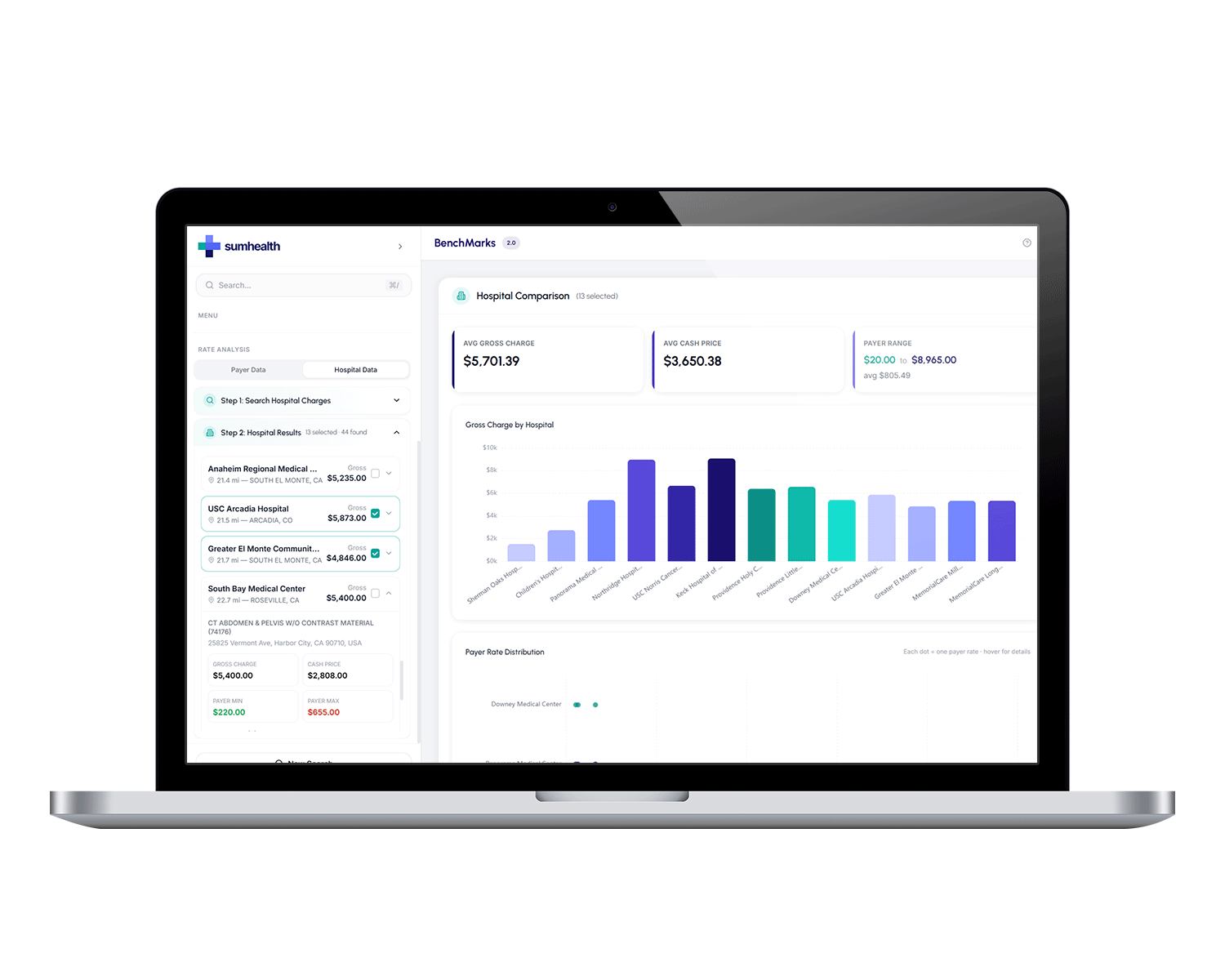
Price transparency, in plain English
What is healthcare price transparency?
Healthcare price transparency is the requirement that hospitals and health insurers publicly disclose the actual prices of care — including negotiated rates, cash prices, and standard charges — so patients and purchasers can compare costs before receiving care. In the U.S. it is anchored by the CMS Hospital Price Transparency rule (effective January 1, 2021) and the Transparency in Coverage rule for health plans (machine-readable files effective July 1, 2022).
What is a machine-readable file (MRF)?
A machine-readable file is a structured data file (typically JSON or CSV) that hospitals and health plans must publish containing their standard charges or negotiated rates. Hospital MRFs list gross charges, discounted cash prices, and payer-specific negotiated rates; payer MRFs list in-network negotiated rates and out-of-network allowed amounts for covered items and services.
What happens if a hospital does not comply with price transparency rules?
CMS can issue warning letters, require corrective action plans, and impose civil monetary penalties of up to $5,500 per day for the largest hospitals — over $2 million per year of non-compliance. CMS issued its first fines in June 2022 to two Georgia hospitals totaling nearly $1.1 million, and enforcement has accelerated since.
When did healthcare price transparency become law?
The foundation was laid in 2010 by Section 2718(e) of the Affordable Care Act, which required hospitals to publish standard charges. A 2019 executive order led CMS to finalize the Hospital Price Transparency rule, effective January 1, 2021, followed by the No Surprises Act (January 1, 2022) and the Transparency in Coverage rule for payers (July 1, 2022).