The Most Expensive Word in Health Care Is "Or"
The estimate is not a price. Four committees voted yes in nine weeks — and not one of them would say what a price is.
A woman in Charlotte needs a knee replaced. She does what the government spent six years and two administrations telling her to do: she goes to the hospital’s website, finds the cost estimator tool, types in her plan, her deductible, her procedure, and hits enter.
The tool gives her a number.
The number is not a price. The number is a forecast. It is what the hospital believes, based on what it thinks it knows about her benefit design on a Tuesday in July, she might owe — a projection dressed in the costume of a fact, with no obligation to be correct and no consequence if it isn’t.
She budgets against it anyway. Because what else is she going to do.
Here’s the part they don’t print on the packet: that gap — between the number on the screen and the number on the bill — is the entire war. It is the only thing left to fight about. And over nine weeks this spring and summer, four congressional committees fought about it five separate times and voted yes every time.
The scoreboard, which tells you nothing
Start with the arithmetic of consensus.
House Energy and Commerce advanced the Lower Costs, More Transparency Act of 2026 (H.R. 9393) unanimously, 45–0. Senate HELP moved the Patients Deserve Price Tags Act (S. 2355) on July 22 by 21–1, with Rand Paul as the lone holdout, and reported it out five days later with two dozen cosponsors spanning Warren to Tuberville. Ways and Means pushed its own version through 25–15. Education and Workforce had already cleared the Transparency in Billing Act unanimously on May 21. And E&C’s Prices on the Wall Act — which would make hospitals physically post cash prices where humans can see them — squeaked through 24–21.
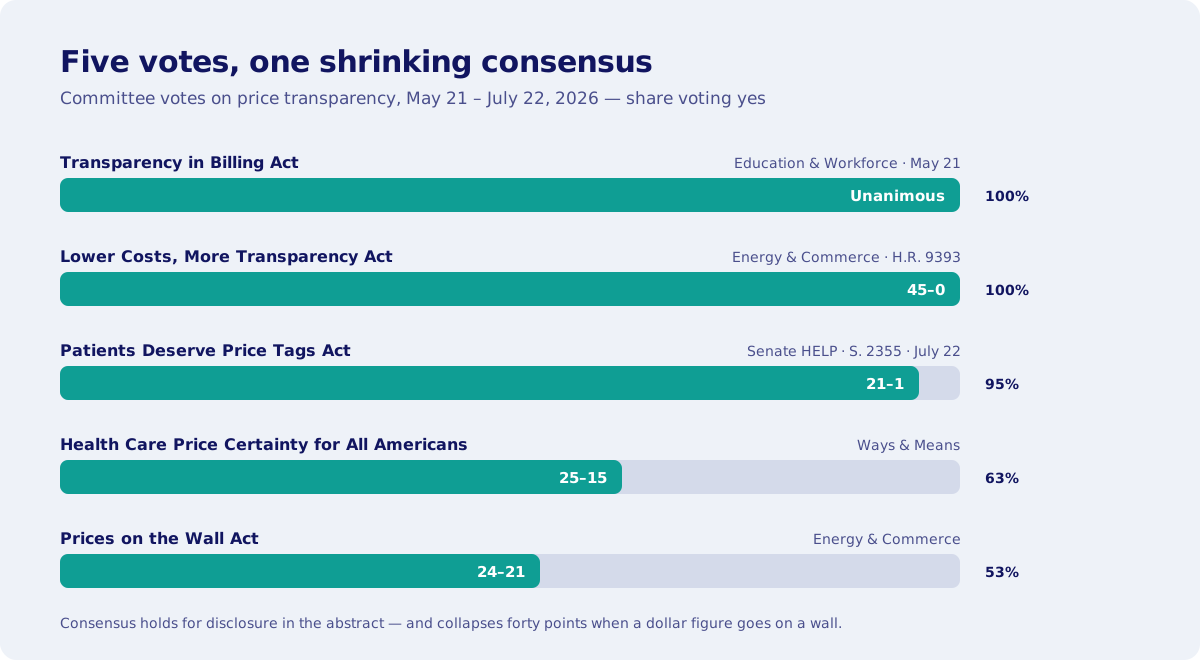
Read that column from top to bottom and the whole story is right there. Consensus holds perfectly as long as the bill is about disclosure in the abstract. It collapses forty points the moment somebody proposes that a dollar figure be painted on a wall.
Ninety-five percent of American adults tell pollsters they want legally mandated price disclosure. Twenty-four senators from both parties put their names on the same bill. The White House ordered this in Executive Order 14221, which demanded, in plain English, “the disclosure of the actual prices of items and services, not estimates.”
Everyone agrees. Which is how you know the fight moved somewhere else.
Where the fight actually is
The Hospital Price Transparency Rule has, since 2021, let a hospital satisfy its consumer-facing obligation one of two ways: publish the standard charges for 300 shoppable services in a format a person can read, or deploy a price estimator tool.
That “or” is doing more work than any other conjunction in American health policy.
The Senate discussion draft released June 25 appears to close it. And on July 2, the American Hospital Association wrote to Chairman Cassidy and Ranking Member Sanders to say, in as many words, that the AHA “opposes this discussion draft in its current form.”
Not the bill’s ambition. Its arithmetic.
The argument, compressed:
“You’re taking away the tool patients actually use.” “We’re taking away the tool that lets you never publish a number.” “Our focus groups with NORC found patients preferred the estimator to the spreadsheet. They found the spreadsheets confusing.” “They found them confusing because they’re built to be confusing. Millions of rows encoding percentages and algorithms instead of dollars.” “An estimator accounts for her deductible. A spreadsheet can’t.” “An estimator also isn’t binding. A price is a promise. Yours is a weather report.”
Both of them are right, and that is the problem. The estimator genuinely gives a patient something closer to what she’ll pay. It also genuinely lets a system spend eighteen months and seven figures building a piece of software whose highest function is to satisfy a regulation without ever printing a rate.
The AHA’s strongest card is not the focus group. It’s the receipt: hospitals sank real capital into those tools because CMS told them the tools would count. Now they might not count. That’s not obstruction. That’s a bureaucracy moving the goalposts on a ten-year build cycle, and anyone who’s ever run a revenue cycle department has earned the right to be furious about it.
One number, two conclusions, zero agreement
Follow the money, but keep your eye on the enforcement data.
CMS has opened more than 7,500 price transparency enforcement reviews. Fewer than 0.01% ended in a civil monetary penalty.
The AHA cites that figure as proof the system works: hospitals get a warning, hospitals fix the file, nobody needs a statute with teeth. The advocates cite the same figure as proof the system is theater: a rule with a $5,500-a-day ceiling for the largest hospitals in the country is not a deterrent, it’s a rounding error on a Tuesday.
Then the AHA plays a card that deserves to land. Of the ten hospitals that got penalty notices in 2025, seven had fewer than fifty beds. Four had fewer than thirty. The enforcement regime built to discipline consolidated multibillion-dollar systems has been landing, with some consistency, on critical access hospitals in counties where the alternative to the hospital is a ninety-minute drive.
And the asymmetry gets worse before it gets better. The Senate draft would have CMS audit every hospital annually — and up to fifty health plans. Fifty. Meanwhile the AHA notes something nobody at the witness table has adequately answered: after six years of Transparency in Coverage, there is no public record of meaningful audit or enforcement activity against insurers at all, and no way to know whether their files comply with anything.
Insurers hold the negotiated rates. Insurers know the benefit design. Insurers are the only party in the transaction who can actually compute what she owes.
Fifty audits a year.
The tell is always in the definitions
Read the two bills side by side and the compromises announce themselves.
The House version lets hospitals post a median cash price. A median is not a price. A median is a statistic about prices, which is a different species of object entirely, and it’s exactly the kind of provision that survives markup 45–0 because nobody in the room wants to be the one explaining central tendency on C-SPAN.
The House version also requires ambulatory surgical centers to post machine-readable files — but not the rates they negotiated with insurers. Labs and imaging centers post everything. ASCs get the carve-out. Ask yourself who was in the room.
The Senate version is the one with the knife in it, and the knife is Section 10. It makes the advance explanation of benefits binding — a patient can’t be billed substantially above the estimate she was given. It bars collections entirely until an itemized bill has been delivered. It fines plans up to $300 per member or $10 million.
That is the whole revolution in one clause: the estimate stops being a guess and becomes a promise.
And here the AHA’s objection stops being lobbying and becomes a real engineering problem. The plan generates the AEOB. The provider gets held to it. If the plan’s number is wrong — and the technical standards for AEOBs, mandated by the No Surprises Act in 2020, still don’t functionally exist — the hospital eats the difference with no appeals process. Uninsured patients get dispute resolution when a bill runs $400 over their good-faith estimate. Under this draft, providers get nothing.
You cannot bind a party to a number it did not calculate and cannot see. That’s not a talking point. That’s arithmetic.
The deadline nobody’s covering
While four committees argued about codification, the agency just went ahead.
CMS began enforcing its rewritten transparency requirements on April 1 — a rigid v3.0 data schema, actual dollar amounts where hospitals used to post estimated allowed amounts, and a named senior executive attesting to accuracy. Then on July 2, in the CY 2027 outpatient proposed rule, it opened a request for information asking the field how to make the files genuinely standardized and comparable.
Comments close August 31, 2026.
That’s the date. Not the markup, not the floor vote that may or may not happen in a lame duck after the midterms. The House bill wouldn’t take effect until January 2028 anyway — which means the majority that wrote it will have faced the voters twice before a single patient sees a difference.
Meanwhile: an analysis published this month found that actual patient bills matched posted prices exactly or closely only 20.5% of the time. PatientRightsAdvocate.org’s most recent review put full compliance at 21.1%. The spread between the highest and lowest negotiated price for the same service at the same hospital has been measured at 2,347 to 1.
One insurer pays a dollar. Another pays two thousand three hundred and forty-seven. Same building. Same surgeon. Same Tuesday.
Four committees voted for transparency five times in nine weeks. Nobody voted to delete the word “or.”
She’s still sitting at her kitchen table, looking at a number that isn’t one.
Sources
- AHA, Comments on Senate HELP’s Patients Deserve Price Tags Act, July 2, 2026
- Sen. Roger Marshall, statement on S. 2355 clearing Senate HELP, July 22, 2026
- James C. Capretta, AEI, Comparing the House and Senate Price Transparency Bills, July 24, 2026
- HFMA, Healthcare price transparency bills advance
- CMS, CY 2027 OPPS/ASC Proposed Rule and HPT RFI, July 2, 2026; comments due Aug. 31, 2026
- CMS, Hospital Price Transparency (April 1, 2026 enforcement start)
- Families USA, statement on E&C committee action
- Executive Order 14221, Making America Healthy Again by Empowering Patients, February 2025
- PatientRightsAdvocate.org compliance reports
- The Hill, Congress can finish the job on healthcare price transparency, July 2026
Ready to see the data for yourself?
SumHealth processes hospital and payer MRF rate data nationwide so you don't have to. Talk to our team about how our platform can power your pricing strategy.
Schedule a Demo